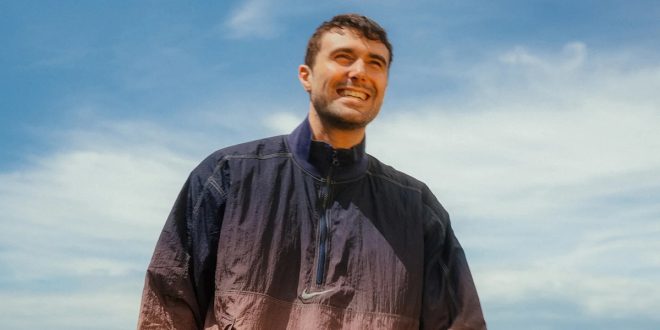

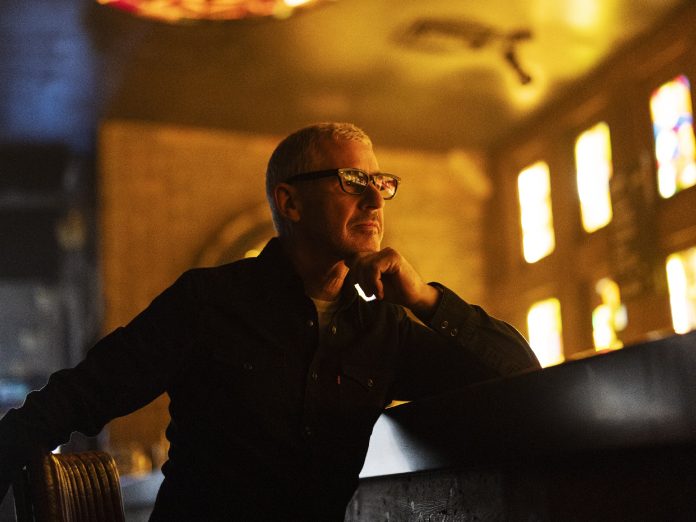
We recently chatted with one of the legends of Dance music for a well-balanced interview that involves Folk, Trance, and everything in between.
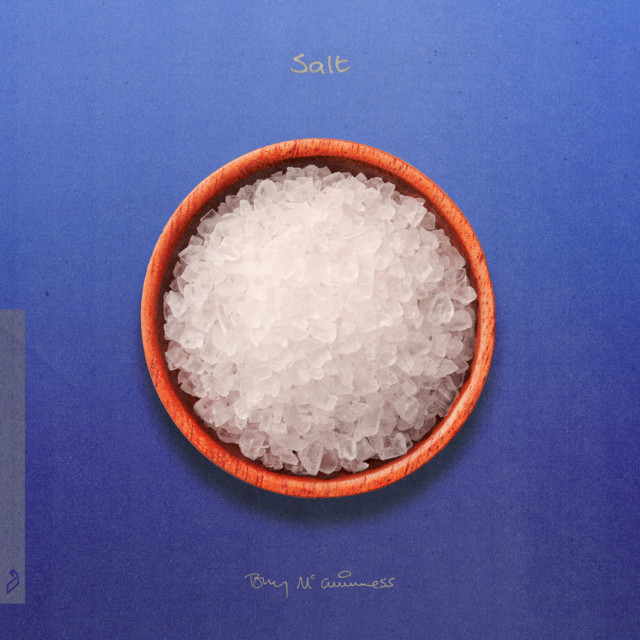
It’s not every day that you get the chance to speak with those who have been at the forefront of music. And this time, we welcomed Tony McGuinness to our site, for a friendly, yet deeply entrancing conversation. Off the heels of his debut solo album Salt, arguably the kickstarter of his career as a lyricist — more on that later —, he’s been enjoying the sheer high of putting these nine tracks out, after practically three decades of them being unreleased.
Foreword

One-third of Above & Beyond, one of the most legendary Trance acts of all time, and also a guitarist and musical composer for the iconic British Rock band Sad Lovers And Giants, AND for years Head Of Marketing at Warner Music Group, Tony McGuinness has undoubtedly been involved in the music industry for quite some time. But before Tony was known as Tony of Above & Beyond, he was another artist, another music industry professional, another man entirely.
Before the mid-90s, Tony felt like he couldn’t really connect with Dance music. He enjoyed it on the surface, though couldn’t see a spot for him and his music on it. That is, until the times of Salt came along. McGuinness wrote the heart of Salt’s nine tracks in a heady six-month burst between 1995 and 1996, the result of a classic ’90s whirlwind romance in London that was popping off with the explosion of club culture in the UK.
How did he go from Folk to Dance? How does he feel by releasing this long-lost, deeply personal album to the world? Which role does Fingerprint, his Organic House Lockdown-born alias, play in this picture? Hold on tight and buckle up, as we talk about that and much, much, so much more, with the man himself, Tony McGuinness.
Now, this interview was quite the long one (which we take absolute pride in), but we understand it might be a tad discouraging to try and find certain topics. So, below this paragraph, you’ll find a little table of contents, so you can easily go and click the part of the dialogue you wish to read. That said, we strongly, strongly advise you read the whole thing through, because we had the most amazing and interesting chat with the chap.
And also, we’re aware Tony has a huge fanbase over in the Spanish-speaking world. So, for all of you, click this link right here to read this article, and subsequent interview, in Spanish.

Table Of Contents
The Interview
(Please note, the bolded text represents a question, while the paragraph(s) following it represent Tony’s answers.)
So, first of all, congratulations on releasing the album!
Thank you!
I think it’s been an interesting time because I think I didn’t realise how revealing the songs were really until I sat in the little album launch we did, where we invited people to come and listen to the album with me. And then I answered a few questions after that, and sitting in the dark, listening to that record, my heart was racing. And I was thinking “I’m gonna have trouble answering questions” because when I was listening to it, it felt very, very personal. More so than I think when you’re working on the music.
When you’re producing music you become slightly disenfranchised from the subject material while you’re working on the mechanics of the song, the guitar parts and everything else. And so it becomes this sort of sound canvas that you’re manipulating like clay, and you’re trying to make it into something that you want it to sound like. When you’re writing a song, that has you with great emphasis placed on the structure of the song, the story structure, maybe the way that the chorus delivers some new information, words that you can use that rhyme, words that have the right kind of metring and rhythm… and so there’s lots of mechanical things that get in the way of the “heartfelt reveal”, if you like.
And I think, for the first time in a long time, I sat there listening to the songs and thinking “this is really very personal, and reveals an awful lot about me”. I think because I’ve sort of hidden behind Richard Bedford in Above & Beyond I’ve said a lot of stuff in those songs that is deeply personal, be it about what it feels like to be in Above & Beyond, to what it feels like to be in the relationship that I might have been in at the time. But you know, Richard Bedford gets the thing, and I don’t think people are really sure where that message is coming from, whereas in Salt, this is clearly me. I’m singing it, they’re obviously songs that I’ve written and performed. So yeah, it’s been… I wouldn’t say slightly embarrassing, but I think there’s more of that feeling than I imagined before it came out.
I understand what you’re saying. I get how it must feel like the whole world is weighing over you because, while you’re producing you’re just coldly focused on the production, but then once everything is done, you do have a final product and it’s not one thing separated into stems, but instead it’s, the whole thing, and how people perceive that whole thing, well, as one single whole.
Yeah, that’s right.
So anyways, I want to know because I don’t think that was anywhere in the documentary: did you ever rerecord bits of these tracks during the past few years or is it all original, untouched stuff from 1990-something?
So what happened was, in 2018 I asked Bob Bradley, who is the musical director to our A&B Acoustic project because of this album and the great job he did on my songs back in ’95 — that’s why I always had in my head for him to do Acoustic —, I said to him, “Look, I’d like to put this out, I’d like to finish it. I think we just get it mixed it will be good enough”. And he said “actually, I think some of the backing vocals have too much bleed, and if you start to process them too much, they’re gonna be unsatisfactory, and some of the guitars-“ — because we only had seven tracks on the original tape, and some of them are dubbed, to dubbed, to dubbed, and everything else — “I think for the benefits of the top end you should get some acoustics re-recorded, or additionally recorded, some electric and some backing vocals too”. I did none of that. Tim Hutton who was the trumpet player in the Acoustic band, who also played keyboards and guitar and sang backing vocals, basically did all of the work in 2018, not to replace but rather to augment what was there.
So if I played you the original 8-track demo, it would sound remarkably the same, except the finals just sound a little bit more hi-fi because the top end of the acoustic is actually there, because it’s been recorded in a digital domain. So it’s the original tapes with a little bit of, I suppose fairy dust. But nothing substantially different, except for ‘Cleaning’, which was never really finished back in the day, and Tim Hutton took the arrangement that we had and put this sort of lovely backing vocal section into it and added some brass and some other bits and pieces. So while that was more of a 2018 production the rest of them are almost exactly as they were back in the day.
And so your voice in every track, is your voice 25 years ago?!

It is indeed! It’s an interesting thing because, you see, in the last 25 years I’ve probably smoked a lot of cigarettes and got a lot older, and in my head, my voice has dropped a lot, so that these songs are out of my reachable range. And I felt like that until the video shoot for ‘Biker Babe’. By the way, I’ve been to lots of videos, but I’ve never really figured out what people do when they lip-sync. Do they just do [moves his lips, laughter] that or do they sing along, or do they sing but in a lower register? I wasn’t really sure what I was going to do.
I’m standing there with the guitar and the microphones in front of me (not plugged in of course, just for the prop), and the and the track click starts and I just started to sing. And I surprised myself by getting to the end of the song and managing to sing it in the original key! And then I proceeded to do the same for maybe two and three-quarter hours, as long as the video shoot lasted and I was okay at the end of it. So I’m like, “maybe I could do this live”. Maybe I could sing these, I think some of them might be difficult, but it is my 25-year-old voice, and it does sound higher, I do sound younger but it’s not a million miles away from how I am now if I sing in that sort of higher register. I do tend to sing lower things for Above & Beyond when we can’t get anybody to sing growly-gravelly stuff. So that’s when we use my voice. Other than that, we use Richard Bedford who sounds like I would like to sound.
That’s interesting because for a handful of years — I got to A&B in 2014-2015 and then I discovered everything before and etcetera , I thought your first contribution as a vocalist was in ‘Making Plans’, the acoustic take. I thought you had never done vocal tracks before.
Well, I did and do all the demos, but then we change our thoughts. When I did the demo for ‘Far From In Love’, that was the first one that we wrote together, we ended up getting a girl to sing that (Kate Cameron), because that’s what you did in Trance music, that’s what everybody was telling us to do.
And let me tell you, her voice is magical.
It is. It is very, very good. But I mean, these are male songs written from a male perspective. And so when we found Richard Bedford, that was kind of, for me, one of the most important things that we did as Above & Beyond, because I think a lot of our fans are men. I don’t mind the women that come to see us [laughter], but I’m writing songs from a male perspective. I think men are, maybe, slightly more romantic than women? I don’t know, but there’s a difference in the kind of songs that I write and the kind of songs that Zoë writes. So I’m happy that a man is delivering them, because I think they need to have that male delivery. That said, I did end up singing ‘Black Room Boy’ and ‘Excuses’, and occasionally, when we can’t find anybody that fits, I end up being the vocalist. But it’s not really our choice.
Thank you. This is a bit of a personal question: did you ever contact Shelley again? And do you reckon she’s got a hold of the news of the album by now?
I don’t know if she will or she won’t. She is a very private person who goes through life in a very compartmentalised way. Once she left the UK she stayed with me for three months, four months, and she went back. We stayed in touch for a little bit, she came back for a little while longer, and then she went away and she moved, and she didn’t send her new number. That’s kind of how she likes to live her life, or liked to live her life. I don’t know what she’s doing now. I think about her often yet I haven’t made a concerted effort to find her. There’s a little bit of the publishing that’s marked for her, for ‘Babydoll White’, but I don’t know where she’s living now, it’s just a mystery to me.
Yeah.
It was a really important moment, she was a really important person to me, but I loved her then, and I respect her, and I think she would rather not be contacted so I haven’t tried.
Going on to another topic, back to the album though. Regarding the order of the tracks throughout the album, is there a thought process behind it? Why ‘Biker Babe’ is first, the title track ‘Salt’ is fourth, and so on? And if so, I guess the right thing to ask is, what is that logic? Allow us to dive in.
You see, Kirsty MacColl, famous English singer, did the track listing order for U2’s The Joshua Tree, and everybody was like “this is just a fantastic order, how have you done it?”, and she said, “I put my favourite song first, and then my second favourite second, and so on”. So there’s a little bit of that, because I think in these days of digital, where everybody gets the chance to hear everything, you tend to find the records at the beginning of an album get listened to more than the ones towards the end. So I wanted to put my favourite three tracks at the beginning, but then after that, I’ve tried to separate the ones that are in 6/8 time from the ones that are in 4/4. And then I put ‘Long Way To Fall’ at the end because that felt like a kind of ending to me. But there’s not really too much thought in it apart from that.
I mean, it does close nicely. I have to agree it is a beautiful closure. Now this is a bit tangential to Salt, but still related to it. A few years ago — a few years ago, holy does it make me feel old to say that —, Lockdown happened, and with it lots of projects came to life. I guess we had a lot of time to spare and so on and so forth. Among those a shy ‘Babydoll White’ single appeared as part of the Anjunadeep Explorations 14 compilation.
Yep.
Now we know that was not the original single. Instead it was a club-inspired take by Maor Levi. How did he get to the track? Did you tell him about the album sometime in the past? And also, was releasing that club remix the first real spark for you to allow the whole album to now be out to the public?
Well, I guess it was a bit of a spark. The day after we played at Mar del Plata (Argentina, January 2020), I went to see Nick Warren play at that same venue (Mute), I don’t know if you were there. But I went on stage and pretended to DJ for a minute when he went to the toilet, which is quite funny.
I wish I was there! But my bus left earlier that day. So I had to go back to Buenos Aires. But I did see videos of you behind the decks!
Oh, right. Well, it was a great gig and there was the same number of people as the other night. I’d always talked to Bossi from Cosmic Gate about doing a Techno set somewhere. I’d always wanted to do something in a different area. I wasn’t really sure what that other area would be, and then I went to see Nick Warren and I listened to what he was playing and I thought, “This is the kind of music that I want to have as a side project”. And then Lockdown happened and then there was the opportunity to do that Deep set.
[embedded content]
So I started one Sunday. I don’t think it was as well thought through as it became, because it became this kind of regular thing. (Tony’s Deep Sets) And so, I’m in this new world with people like Nick Warren and Hernan Cattaneo, Weird Sounding Dude, Alex O’Rion, all these people I’m getting in touch with and getting music from, and I thought it would actually be really great to do something in that area. But I thought the last thing anybody would want in that area of Organic House and Progressive House is Above & Beyond. So I thought I would pretend to be something else.
And so I invented this little alter ego called Fingerprint, and I was chatting to Maor one day about something completely unrelated and I said to him, “if I send you a little bit of vocal, could you do a track in the style of my Sunday sets for me to play?”. And then he did, and it took him all of, I don’t know, a day and a half? Something like that, And he just nailed it! And it was so good! And then I thought, “Have I got any other ideas lying around?”. So ‘Rye & Eggs’ was this demo, which I’d actually done on this computer, never really got anywhere. It was just an afternoon’s work. But I thought, “Maybe I could get an Organic House version of that”, so I sent that to Maor as well.
And then there was another version of ‘Home’ that I’d remixed which he did a new version of. And so he became my go-to guy during Lockdown to get Organic House records under my pseudonym out there. I didn’t realise that you knew it was him! Because Mem Aleph was a pseudonym for him as well. But I guess we all know now. [laughter] And the funny thing was that, the more I spent in that world, the more I realised — because obviously A&B was completely on hold so there was no day job to do, there was nothing really to do, we weren’t touring; we were just, you know, taking time to be creative, I guess —, ironically, what I found was that people actually loved Above & Beyond in that world. 90% of the people that I spoke to were from South America and they all loved the fact that it was Tony from Above and Beyond behind Fingerprint. And so, probably if I had my life to live over again, I would have released those tracks as just Tony McGuinness. But who knows. I don’t know if I’m answering your question, I’m sort of waffling around the point a little bit.
I love it. I actually love it. So just tell your story, go on. The more the merrier! [laughter]
There was that. Both of them did rather well, I think in their own way. I still have a love for Organic and Progressive House. I don’t do the sets anymore, I just don’t have the time. They used to take me the whole week to prepare, you know, to get all the music. To download four hours of new music and get it to sound good in a mix together is a lot of work and I just haven’t got the time to do it anymore unfortunately, so I never really learned to DJ that kind of music off the cuff. It was all a very planned broadcast, you know, two hours, three hours, four hours, six hours sometimes. But planned to the nth degree so that it sounded like it never took a step backwards, always slowly growing. And so I think that’s one of the reasons why those sets did so well, they were kind of not real DJ sets at all. They were more like compilations, I think.
I mean, they tell a story. My friends and I used to wait all week long to tune in. I preferred your Wednesday sets when you recreated Trance sets, but then a friend of mine who’s rooting for you as Organic House and everything, got me into the genre, and it happened to me with you like it happened to you with Nick, I was like, “wow, what’s this world?!”.
Well, it’s come full circle because as Above & Beyond we’ve done a couple of Progressive House tracks with PROFF that just came out. One’s called ‘Palermo’ after Palermo Soho and the other one’s called ‘Fractals’.
Now, I didn’t plan to ask this, but I was super curious if ‘Palermo’ was named that way because of Palermo, Argentina, or it was because of Palermo, Italy.
No, Palermo Soho.

Argentina loves you. You’ve kind of answered another question I had for you, which was, if Fingerprint was a passing cloud for you or if you see it coming back sometime in the future?
I don’t see any need for it anymore. So, you know the things that we’ve done with PROFF as A&B now, I’m not sure if that’s good for the genre on reflexion, but that’s just the way that we decided to do them. I think they’re important for Above & Beyond, we’ve got a Deep set coming up in Finsbury Park for Anjunadeep so we wanted to do something in the Deep world, and these things just happen naturally when you’re in the studio, you know?
Exactly. Now I’m curious to know — although you touched on it just a while ago —, if ‘Babydoll White’ is a track that became part of Salt, I want to know, what’s ‘Rye & Eggs’? Where does it belong?
‘Rye & Eggs’ was a track that I made on this computer, in this small studio. It was an afternoon, it was an attempt to produce in Ableton, which I had not done before. I played that guitar, [points to the guitar] I fucked around with it, but it never really had a proper direction, it was just a minute of music. And when I was talking to Maor during Lockdown and he was turning these things around so quickly I said, “could you do something with this?”, so that I had two Fingerprint things to put out on the on the Anjunadeep EP.
That’s magical.
So it was a weird piece of very un-Organic House music that made itself into an Organic House record.
Allow me to tell you that record sounds like the perfect blend, to me, of Gustavo Cerati and Sad Lovers And Giants. I feel like it’s right in the middle.
Well, that’s interesting. I think the great burden of Sad Lovers And Giants is, you get used to stuff that’s not really in the right key or it’s a very atonal kind of music on occasion, with lots of, I think PROFF calls them “brown notes”, in it. Sad Lovers And Giants is jazzy, I suppose. And so when I’m sort of thinking about what sounds right to me musically, it often is a problem for Dance music because the chord sequences I come up with are too weird. They work for me, but they don’t necessarily work in Dance music. You need to have, I think, fairly standard chord changes in order for Dance music to really be able to get a hold of it. You can’t have semitone changes and things like that, but you can do anything when you’re writing songs for yourself and strumming guitar and making music for SL&G.
I mean my life in Sad Lovers And Giants is interesting because the bit that I do for Above & Beyond is the bit that I don’t do with them. I do all the music for Sad Lovers And Giants and then the singer does the writing of the songs, whereas with Above & Beyond, I do get involved in the production obviously, but It’s the writing that is my main job in the band.
Yeah. And I think Lockdown kind of taught us, it’s mostly Jono behind the production, because when he started doing his own things, it all sounded eerily similar to Above & Beyond, you know? Take away a few things that are kind of your iconic characteristics of the band, but the sound was basically his.
Yeah, I think he’s been more than anyone, sort of responsible for the signature sound. But Paavo does the production as well and he’s always done production in the past.
Just as a side comment, just because we’re touching on the topic, now that you’re all doing three separate solo projects, you can kind of see who contributes what to the A&B sound, and I love that, to kind of deconstruct everything and see “oh, this comes from Paavo, this comes from Jono, this comes from Tony”. I don’t see Andrew (Bayer) though, he’s done a good job of hiding himself.
I mean, for me you can hear Andrew. When Andrew started working with us was around the time of ‘Sun & Moon’ and the Group Therapy album, and I think his fresh grooves, let’s put it that way, and kind of aggressive grooves, are really important, yeah, but his musicality can’t be doubted. I mean sometimes he and I will write a song together when everybody else is away, that’s the way it used to work when he was working here and I love his musicality, I think he’s a very fresh producer, really great on grooves but musically he’s a genius.
I have to agree. Now back to Salt, let’s imagine for a second that you recorded this tape when you did, back in ‘95, ’96, and released it one or two years later back then as your debut solo album just like you did now, but a couple of decades ago. Do you think that would have changed who you are today? Would you, for example, have met Jono and Paavo?

It’s a really good question. I think probably I would have released it on my own label as I had a label that was releasing Sad Lovers And Giants music, and it would have been something that I would probably have aimed at the Sad Lovers And Giants fanbase because there was no Above & Beyond fanbase at the time, and nobody knew me apart from people who worked at Warner’s and people in the music business, maybe, but I don’t know, I wonder.
I think the world was a very different place back then, there wasn’t nearly the amount of music being released that there is now so it would have been interesting to see what would have happened to it. I think it’s hard, it’s difficult to think whether that eventuality would have changed what came after it or not because I was into that kind of music anyway. It was discovering ecstasy that got me into Dance music and that was like, it happened in a heartbeat. Before my ecstasy experience, Dance music was interesting but a little bit naff, I think, and real music like the Cocteau Twins and everything else was really important and real, whereas Dance music was a bit jokey. And then I went to the Ministry of Sound and did an ecstasy tablet and my life changed, and my perception of Dance music changed instantly, and then maybe a couple of years later I started hearing Trance music, Robert Miles’ ‘Children’, I remember the first time I heard that, and Disco Citizens’ ‘Footprint’… there were these sorts of records with strings in, I guess that was the thing, and piano too, and they were in a minor key and they sounded more like Sad Lovers And Giants than House music did, and I thought “this is a kind of music that I could make”.
So I think whether or not I’d been making guitar-y records — I mean I still write songs, I have most of the songs that I write come out through Above and Beyond but occasionally I’ll write something that doesn’t feel like it’s right for Above & Beyond, and I produce it in an acoustic manner, I don’t turn it into Dance music, so I still love that kind of music.

Actually, I’ve got Apple Music and Spotify, and on Apple Music I listen to Dance music and on Spotify I listen to Folk music, so that the algorithms don’t get completely confused because as a songwriter, which is kind of how I see myself, my day job really, I want to hear really good songwriters, I want to hear the world’s best songwriters and that sort of diet I get from my Spotify algorithm, and then if I want to listen to Deep House or Trance or Electronic music then I use Apple Music, and I think it’s a nice thing depending on what kind of mood I’m in.
For me, songwriting is an interesting word experiment and I’m not brilliant, it takes me a long time to get the lyrics right and one of the things that helps a lot is listening to somebody else singing their songs. For some reason it’s like a catalyst for me, it frees me up. So I was in Argentina a few years ago, before 2020, I think 2017, walking around listening to the Cubicolor album, the first Cubicolor album (Brainsugar), whilst writing ‘Bittersweet & Blue’ and another song from that album, I can’t remember, but I do remember that I found hearing somebody else’s perspective, another artist’s songs that look at this or that thing from a particular angle — and it can be a very strange angle — makes you think, “well, I could write something from that angle”.
Yes.
It’s not, you’re not stealing the words, you’re not stealing the rhythm or the tune, but it’s just a kind of, human perspective I find really, really helpful. And so when I’m doing my ironing, I still do my own ironing because nobody can do it better than me, [laughter] I like to listen to my Spotify Recommended, Weekly Recommended, and I’m forever running around from the back of the ironing board going, “who’s this?”, and checking out who’s been presented.
I think there is a bewildering array of musicians now, increasingly solo musicians. Somebody was telling me there was a statistic about what percentage of the #1s of the USA were made by bands and looking into the 80s and 90s and 00s and now. And I think it used to be 140 days of the year out of 365, the number one spot was taken by a band in the 1980s, and now it’s just three percent (around 11 days).

Well, the world’s gone solo. We’re all turning into Johnny-no-mates! We’re at home. We’ve got the equipment to make music. We don’t need to put an advert in the local shop for a bass player and a drummer and a keyboard player because we can do it all ourselves. So I’m hearing an awful lot of solo singer/songwriters with an acoustic guitar, but I love that kind of music. I just love the simplicity of it, the honesty of it. And generally speaking, in that world, the songs are autobiographical and honest and revealing. And I really appreciate that. I think in Dance music, we tend to hide behind featured vocalists, and that’s OK.
I mean, that’s OK up to a point, but for projects like this, because, for example, Salt, it’s got to come from within. It’s something so personal to you that I don’t think it’s… For instance I’m not sure if you ever used autotune for this, to pitch correct or something, but I don’t think it’s even worth it because it kind of ruins the whole naturality of it.
Yeah, what we used to do back then was record something over and over and over again until you got it in tune. So there’s no need for autotune. But people don’t have the patience for that anymore. I mean, we (A&B) don’t. We work with singers and they’ll sing it once and they’ll be like, “that’s a bit dodgy, but you can fix that, can’t you?”. So, you know, we can. But what you had to do in 1995 was sing the bloody thing over and over and over and over again until you got it right, which is kind of the same thing. When people say they never used to have autotune, but they did 16 takes. Some people nail take number one, though.
I see. Well, it’s a good thing that we were talking about the past and the albums and so on and so forth, because now I’d like to take you into a different direction, sort of away from Salt. A few months ago, I wrote an editorial on our site kind of going about and addressing the current state of the albums, the album, the concept of the album, how it’s delivered and everything. I do have my take as a devoted listener and a producer and everything, and I’m a true fan of the long stories and the journeys that albums bring. But I’m conscious that society is not about that fuzz anymore. So I’d love to hear your thoughts on that matter.
I think you’re right. Our attention spans are famously getting shorter. I don’t think they’re as short as people think they are, but I think apps like Instagram with Stories and TikTok, it’s instant gratification with very short subject matter, and it’s just making us, I think, impatient for things, whatever they are, movies or music, to get to the point quickly. That being said, we are watching longer movies than we’ve ever watched. I mean, Breaking Bad is a 60-hour movie. So you could argue people have got the patience if things are well done.

My view on albums is they are the artist’s playlists, and if you are interested in the artists — and I think most successful artists are successful because people get interested in them apart from their music — you care about the order in which they would like you to listen to these N tracks that they’ve released. It is important, I think, even if it’s just a my-favourite-ones-at-the-beginning thing. But I’m a big fan of albums. I’m a big fan of the process of getting an album and listening to it and digesting it, and I find it’s more of a struggle to do that than it used to be when you used to have to buy a record and put it on a player, and it was playing on a device that didn’t send you messages from your mom or a newsflash that Donald Trump had been shot or whatever else. It was just a record player or a CD player, and you were listening to music and you’ve maybe got somebody around and you’re chatting in the background, but you’re ostensibly listening to music on a music playing machine, like you watch TV on a TV. TV doesn’t interrupt the process of watching TV as phones do.
I think that listening to an album is still, for me, a really pleasurable process, and I put a lot of value in artists being able to make a good album that sounds great from start to finish, that has a cohesive personality, that takes you on a journey through the mindset of the creator. I think that’s a really amazing thing, and music’s really the only place where you are honestly connected to the thought processes of the creator in a very literal sense. Though the words and our feelings get turned into poetry and rhyming poetry with a melody, which is not entirely literal, if somebody’s singing ‘Alone Tonight’ and you’d known it’s me that’s written that song, then you can imagine what state of mind I was in when I wrote it. I think that’s a really lovely thing, and the thing about an album is people aren’t so simple that one song can define them. Most artists are a little bit more complex than that, so I love albums. We’re going to be making an album that’s Above & Beyond soon. We’ve done EPs, we can do EPs, anybody can do EPs, but I think for us, especially with three people with so much to say, if we weren’t doing at least an hour-long album, I think there’d be stuff that’d be left out.
And I think as Above & Beyond, how I’ve seen you over the years is, okay, there’s singles in between and there’s these banging instrumentals that you can play at a club, and the pyros go off and everyone is shouting and screaming and jumping around, but albums are something more grown-up, mature, and they mark a chapter in your career, as I view it. There’s the Tri-State era, there’s the Group Therapy era, and so on.
Yeah, I agree. I mean, I’m actually really proud of all the albums that we’ve done, but we made a concerted effort when we made Tri-State to do something that had the hallmarks of, say, Dark Side of the Moon. It wasn’t a compilation record, it was something that would be good to play at home. That was a really, really conscious decision, and I’m really glad that we did that and set ourselves that stall as an example of what we aspire to, I suppose.
Tri-State is an album that I love with all my heart. Something interesting happens to me when I listen to it; I cannot stop listening to it, I cannot press the pause button, at least until after, ‘In The Past’. I think I go through half, plus one or two tracks, before I can even press the pause button, because everything is so seamlessly woven together. I don’t know how you got to that.
Well, we got to it because of Dark Side of the Moon, and also, there’s an album by The Timewriter, who is a German Tech House producer that I was listening to back then, that had these interstitial pieces. So that’s where ‘In The Past’ comes from. It’s like it doesn’t need to be a whole track, it can be just a little tone piece. And that was, I think, probably the seed for Flow State and the other piano things that Paavo’s done. Just these little kind of two-minute, three-minute, not sketches, but things that aren’t trying to be a song. They’re interstitial pieces.
That’s awesome. Now, Salt is a very different project to what everyone who’s listened to you since at least the year 2000 associates with you, because we’re used to the four-on-the-floor and everything. But did you ever fear backlash from your fans and followers for putting out such an album? I asked Paavo the same thing with P.O.S, so don’t feel attacked at all.
No worries. It’s a good question. I mean, I think when we did Acoustic, that would have been, I suppose, the time to get that backlash. And people were generally very accepting of that whole idea. It’s gone on to be, I think, for some people, the most enjoyable thing we ever did. So perhaps the idea of playing things in a more band-like format is not alien to our audience, especially if it’s been produced by Bob Bradley. It’s got that kind of common tonality to it. Not all of it’s produced by Bob Bradley, I should add. Some of the stuff I had to do on my own when he didn’t want to do it anymore. But his influence on Salt is very clear, at least for me.
So, this is my last question, I had another one but you’ve already answered throughout the interview [laughter]. So, where and when does music start being an essential part of you and your life? We’d love to know how Tony became Tony, probably even before Sad Lovers And Giants.
I remember music was always at home. There was a piano at home. There was a guitar at home. But it wasn’t until I was about to go to university and went to see The Cure and looked at Robert Smith on stage, and I thought, “that’s what I want to do. I want to do that thing he’s doing”. I thought, “I have to have a jazz master. It’s essential to do that”. And that was kind of the start of it, as something that was a conviction, I suppose, for me to make music somehow, to write songs. I made myself a guitar when I was at university from an old guitar, bits of guitar that somebody had lying about.
I used to spend Friday nights in when everybody else was going down to the pub, and I’d be at home learning to play the guitar and writing songs. And I guess never really getting anywhere, except Sad Lovers And Giants is quite a big sort of cult thing that I ended up in. But the songwriting was always something that I was doing for myself, ostensibly. And I had no idea when, I mean, the timeline of it is, I was writing songs, but from a belief that other people’s stories were worthwhile. So if was inspired by a film, I’d write a song about the film, or a book. ‘Carry Me Home’ is actually inspired by a book by J.P. Donleavy called ‘A Fairy Tale of New York’ — which The Pogues used the title of for their big Christmas hit. But that song is kind of inspired by the first few pages of that novel.

And that was where my head was at, that other people’s lives and other people’s stories were worthy of being immortalised in a song. And then Shelley came along and said, “go and get your guitar and sing to me”. And that was all the inspiration I needed to start writing songs about my own life and my own experiences. And so the period of sorts and the years that came after it were me learning to exercise that muscle. And then suddenly Above & Beyond appears. And Above & Beyond appears as a remixed outfit in Dance music where most of it was instrumental. I mean, not that I really listened to that many songs in Dance music at the time, but ‘Children’ was an instrumental, ‘Footprint’ was an instrumental. It wasn’t necessarily a thing where somebody was singing. There were Vocal Trance tracks around the world, but I didn’t really analyse them that much.
I didn’t really ever think I could write those kinds of songs. I can use the same process that I’m doing to write these Salt songs, and the songs that came after, and just do them at 128 or 138 to a 4/4 beat, maybe have a more imploring chorus. I think that’s one of the things of Dance music, because it’s so big, it requires a chorus bigger than the one that there is in ‘Crying’, for example. I think that’s a great chorus, but it’s not going to survive the big room.
So there was a slight change, but I found myself being able to write these songs that seemed to connect. ‘Alone Tonight’ was the first one, really, I think, where we all got sort of goosebumps when we saw the effect of it at Global Gathering on a tent, full of sweaty men. We just didn’t really think that that kind of stuff would connect, but it did. So I think it’s been one of those things I’ve always enjoyed. I always wanted to do it successfully so that other people would hear my music and sing it, perhaps, but it happened in the most unexpected way, because I think when we started Above & Beyond, the last thing I was thinking is “these songs that I write are going to have a home in this thing”. It was remixes of Trance music. And what place do sad breakup songs, where do they live in Trance? And it turns out they worked really well.
They do have a space of their own in the Trance world, at least now, looking back.

Well, they do. And I think that was a surprise, a delightful surprise to me. So I’ve ended up, in a very selfish way, doing exactly the only thing I can do with any competence, and with it being successful I was very, very, very lucky, and I feel very privileged. But if it wasn’t for Shelley saying, “go and get your guitar and sing to me”, I don’t think I would have had the guts to project my life into these stories. It was her who gave me the confidence to do that. So in some ways, as one of the guys in the label said, as lyricist for Above & Beyond, it’s kind of my origin story. This is the point at which I discovered that voice, not literally the voice that you hear in ‘Making Plans’ and other places, but the voice as in terms of the lyrics and the songwriting.
I’m flattered. I didn’t think we would get to an hour of talking, but it’s been a pleasure to me, of course. I hope it’s the same on your side.
(End of the interview)
Final Words
I’ll break character and address my personal point of view first. Pinch me a thousand times and I still won’t be able to fully process just how good this interview was. Tony is a legend, yet not a rockstar at all. We laughed, we chatted, we went full-on about every topic, and the final product is simply unbelievable. I’m genuinely flattered. He’s been a role model for me for close to a decade now, so yeah, there’s that too.
As EDMTunes, we can only thank him for weaving, with us, such a unique instance. This piece is so much more than just “sit down and talk to us about your new album“. It dives deep into the archives and unveils an entirely new dimension of his character we didn’t know before. Thank you, Tony, and all the team behind that made this one possible. We hope you can get a few quotes from here and apply them to your life. After all, the most beautiful thing about interviews is that they show a more personal side of an artist who’s mainly known for their art, instead of themselves.

You can stream Salt, Tony’s origin story, by clicking right here, or alternatively, by heading below to the Spotify button we’ve attached.
Thanks, T!
Cover image credit: Dan Reid