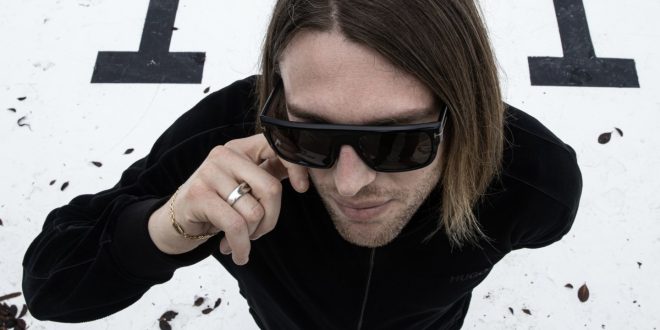


High-flying electronic talent 19:26 releases another forward-thinking release with his upcoming The Threshold EP, landing via Interstellar Recordings, a label known for championing boundary-pushing sounds across the electronic spectrum. Interstellar Recordings reinforces its commitment to showcasing cutting-edge electronic music. It also provides a platform for rising and established artists alike. 19:26 is an Italian electronic music project blending cinematic emotion, neoclassical undertones, and forward-thinking electronic sound design. He has had standout releases on esteemed labels like Afterlife and Siamese. As a result, he is seen as one of the most forward-thinking artists of his generation.
The Threshold EP
Blending emotive Melodic House and Techno textures with cinematic sound design, the EP explores the space between tension and release. It captures the moment just before the transformation. Each artist brings a distinct voice to the project. This results in a cohesive yet dynamic body of work that feels both introspective and club-ready. London-based producer Gadouh joins him on ‘Give Me Life’. he masterfully fuses Western and Eastern influences into deeply expressive productions. He continues to expand his sonic identity here. Moreover, his contribution sits seamlessly alongside the atmospheric palettes of 19:26. This forms a track that is as immersive as it is impactful.
Interview
We also sat down with 19:26 to discuss the release. Read on below.
How has your year been so far, both personally and musically?
It’s been an intense year, in the best way. Everything accelerated very quickly, both professionally and personally.
On the music side, a lot happened. The debut EP The Passage on Afterlife Recordings, Giza with Anyma, Reserva with Mrak.
And the chance to bring my music around the world, with long tours across the US, LATAM and Asia, many of them sold out.
I’m grateful for that. It doesn’t feel normal yet.
On a personal level, I found something stable. A relationship that keeps me grounded and genuinely happy.
The only downside is time. I barely get to see my family in Italy now. Just a few days a year.
That’s the trade.
Where did the name 19:26 come from?
It’s something I grew up with. A number I used to see everywhere near my grandparents’ place in Naples, a city I’m deeply connected to. It became a reference point, like a silent marker of where I belong.
Those numbers are actually the founding year of SSC Napoli, and you see them all over the city.
I’ve kept them with me since childhood.
You’ve been building momentum with releases across labels like Afterlife, Siamese and Interstellar — how would you describe where you’re at creatively right now?
More precise. I’m obsessed with sound, and I’ve definitely become more selective. I’m evolving, but it’s a natural process.
I spend a lot of time in the studio searching for the right sound, new arrangements. It’s a path with no real end.
At this point, I just need to feel something that captures me. I can recognize that feeling immediately. And that’s enough.
Your sound blends neoclassical elements with melodic house and techno — how did that fusion first come together for you? Who have been your biggest inspirations?
It wasn’t planned. It came from the contrast between structure and emotion. I come from a very disciplined background, but I needed something that could break that rigidity.
It’s hard to point to a single influence, because it’s always a combination of different inputs. But if I have to name one, I’d say Traumprinz. All his aliases.
Can you tell us about a formative musical experience that had a lasting impact on you as an artist?
Hearing my grandmother play the piano for the first time during a summer holiday. She hadn’t played in years, after teaching at the conservatory. That’s when music entered my life.
What was the initial idea or emotion behind The Threshold EP?
The moment before change. That space where you know something is about to shift, but you’re not fully ready to let go yet.
What gear do you use to make such music? What is your studio set up like?
A laptop and a pair of headphones. That’s all.
I do everything in the box. Sometimes I like to finalize my music in proper studios. I just finished a session in Taipei.
How did the collaboration with Gadouh on “Give Me Life” come about, and what did he bring to the track?
It started very naturally. We have a mutual friend who kept sending me his demos. I didn’t open them immediately, but after a few days I finally listened and found the idea really interesting.
I asked for the stems to work on it, and that’s how it started. Gadouh brought instinct and freshness, something raw and immediate.
I tend to refine things a lot, so that contrast created a balance.
Ascension with Mariz feels like a different kind of journey — how did that partnership develop and what was the creative process like?
With Mariz it was a different story. We were already in touch, I knew him, and I had been supporting his music. So this collaboration was more planned from the beginning.
The process took a long time. We worked on the track for over a year. It’s definitely more dancefloor oriented.
When I tested it at the Pyramids of Giza, I understood it had something special.
Do you approach collaborations differently compared to solo productions?
Yes, definitely. Collaborations take you outside your own space.
Alone, I can be ruthless. In collaborations, you have to leave space.
There’s a strong cinematic quality to your work — do you draw inspiration from film, classical music or other art forms?
Definitely. Film, architecture, sport, music.
Music is just one layer of a bigger picture.
What was the last record that blew you away?
An unreleased one from Mathame.
What can we expect next from you?
Definitely a continuation, not a reset. I can’t say much yet, but there will be important announcements soon.