
It’s refreshing to see music that refuses to play by the rules of an algorithm.
Whenever you’re hunting for a groove that feels truly grounded nowadays, you’re very likely to stumble into a sea of “formulaic” electronic tracks designed for quick playlist recognition. There is nothing wrong with a standard club heater, but sometimes you want to dig a bit deeper and find a sound that breathes. Something that feels more like a ritual and less like a product. Enter Olendo.
With past releases on labels such as Sounds Of Sirin and Be Adult, Olendo kicks off 2026 with the Folklore EP, a two-track release that perfectly scratches that itch for organic, intentional movement. Rather than chasing uniform tempos or predictable drops, this project is a musical journey rooted in global percussion, hypnotic congas, and textures that feel both ancient and alive.
What makes Olendo stand out is the commitment to feel over formula. The compositions are built to be felt, not just consumed, inviting the listener into a world of trance and subtle motion. It’s a project made for those who move with instinct and seek depth in sound—an invitation to step away from the trends and into a world shaped by pulse and organic ritual.
And it’s precisely that quality that led us to have a little chat with him, to get a first-hand testimony of what an artist prioritising art over metrics looks like. So, without further ado, here’s our interview with Olendo.
Where did you grow up, and how did your environment shape your relationship with music?
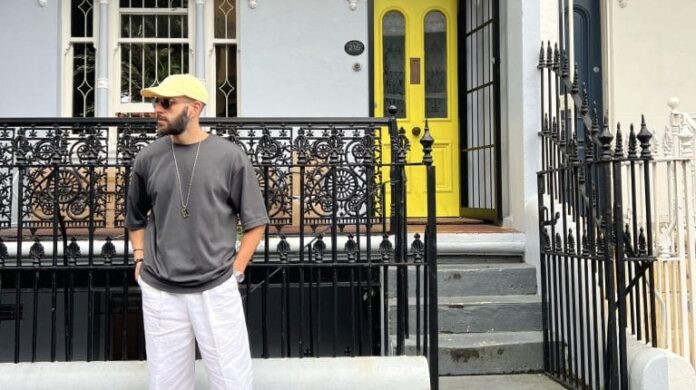
I grew up between cultures. I’m Greek by heritage and grew up in Australia, which meant music was always a bridge between identities. At home, there were Greek melodies, traditional rhythms, and emotional storytelling. Outside, I was surrounded by a mix of electronic music, club culture, and global sounds that reflected a multicultural environment. That contrast shaped how I listen to music, not as something fixed, but as something fluid and evolving.
Being exposed to different cultures early on made me sensitive to feeling over genre. I didn’t grow up thinking in terms of categories; I absorbed emotion, rhythm, and atmosphere. That’s why my relationship with music has always been more intuitive than technical. Olendo comes directly from that upbringing… music as a place where different worlds can coexist naturally.
What’s the first memory you have of making music?
My first memory of making music was back when I was 11 years old. I stumbled across a demo version of fruity loops on my mates computer & I was hooked. I remember experimenting with sounds purely to see how they made me feel, without any sense of rules or outcomes.
That mindset stayed with me. Even now, when I start something new, I try to return to that place of exploration rather than expectation. The moment it starts feeling forced or goal-driven, I know I’ve drifted too far from why I started.
When you think back to your earliest projects, what’s something you would do differently now?
I would trust my instincts sooner & always make sure that the track has a groove. Early on, I spent too much time overthinking structure, worrying about how things would be received, or comparing my work to others. That slowed my growth more than any technical limitation.
Now, I understand that clarity comes from commitment. Even if an idea isn’t perfect, fully believing in it gives it strength. Those early projects were necessary stepping stones, but if I could go back, I’d allow myself to be more confident in my own taste.
Who are the artists or sounds that most shaped your style early on?
Early on, I was deeply influenced by music that felt hypnotic and emotionally grounded rather than overtly functional. Artists and scenes that blurred the line between club music and storytelling left the biggest mark on me. I was drawn to organic textures, tribal rhythms, and melodies that felt ancient yet contemporary.
I also gravitated toward artists who weren’t afraid of space, where silence, restraint, and repetition were just as important as melody. That taught me that power doesn’t always come from complexity, but from intention. Those early influences still echo through Olendo, even as the sound continues to evolve.
What’s the one element every track you release has to have to feel complete to you?
Every track needs to carry a groove that makes you move & it also needs to have a sense of atmosphere. Even if it’s rhythm-driven, it has to feel like it exists in a space, physical or emotional. If I can’t imagine where the track lives, it doesn’t feel finished.
That atmosphere doesn’t need to be obvious. Sometimes it’s created through texture, sometimes through restraint. But without it, the music feels empty to me, regardless of how technically strong it might be.
Can you describe how your creative process typically begins when starting a new track?
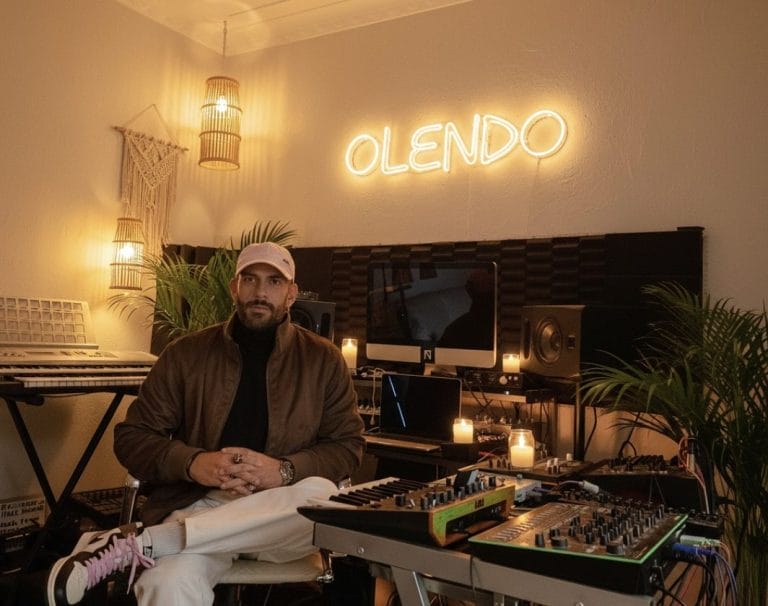
When I am making more upbeat tunes (anything greater than 115bpm), I usually begin with the drums & bass. Once I am happy with the groove, I then usually move on to the melodic layers & vocals. Following this I work on the arrangement, automation & effects.
When I produce more downtempo tunes (usually anything less than 110bpm), I vary my production style. Sometimes I will start with the beat, other times, I will start with the melodic layers. Either way, regardless of the bpm of the track, I have to feel connected to the sound or sample, otherwise I find it extremely difficult to compose the track.
What do you think is missing in the music industry right now?
Patience. There’s an overwhelming pressure to be visible, productive, and constantly releasing. That pace can strip music of depth and intention. Some of the most meaningful records need time… time to be made, and time to be understood.
I think the industry could benefit from slowing down and allowing artists to develop identities rather than just outputs. Longevity comes from voice, not volume.
Why do you think some artists become trendsetters while others just follow trends?
Trendsetters usually aren’t trying to lead anything, they’re trying to be honest. They make decisions based on instinct rather than reaction. Because of that, their work feels grounded and inevitable rather than strategic.
Artists who follow trends often start from the outside, observing what works and then adapting to it. There’s nothing wrong with that, but it rarely creates something lasting. The artists who stand out are the ones willing to sit with uncertainty and trust that their perspective has value.